
As we age, skin laxity gradually becomes more noticeable, the jawline softens, the cheeks begin to descend, fine lines and wrinkles become more apparent, and the skin loses some of the firmness it once had. Two treatments often come up in this conversation: thread lifts and radiofrequency (RF) skin tightening. Although both are grouped under ‘non-surgical lifting’, they work very differently, and understanding the distinction matters when it comes to choosing the right approach for your skin.
A note from Cove Aesthetic Clinic: We specialise in non-invasive skin tightening treatments — we do not perform thread lifts. We’ve written this comparison to give you an honest, full-picture view of both options, including treatments you may need to seek elsewhere, so you can make a properly informed decision about your skin.
Skin ageing is not caused by a single factor. Rather, it develops gradually through a combination of biological changes and external influences that accumulate over time.
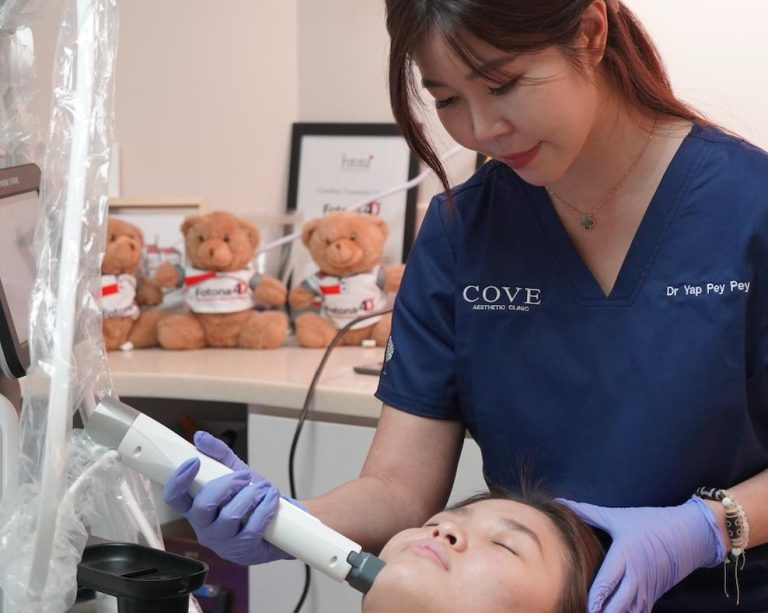
Radiofrequency skin tightening is a non-invasive treatment that uses controlled thermal energy to heat the deeper layers of the skin. This heat stimulates collagen remodelling [3] and encourages the production of new collagen fibres over time.
Unlike surgical procedures, RF treatments do not involve incisions or tissue repositioning. Instead, the goal is to gradually improve skin firmness, elasticity and texture through collagen stimulation. Modern RF technologies can deliver energy at varying depths depending on the device being used. Some systems target the superficial dermis, while others can penetrate deeper layers to address more significant laxity concerns.
At Cove Aesthetic Clinic, we offer XERF, a monopolar radiofrequency technology that delivers controlled thermal energy across multiple skin depths to stimulate collagen remodelling. Our doctor will assess your skin during consultation and advise whether XERF is the right approach for your concerns.
Because RF tightening works through collagen regeneration, improvements tend to appear progressively rather than immediately. Some individuals may notice mild tightening early on, but more visible changes often develop gradually over several weeks as collagen remodelling continues.
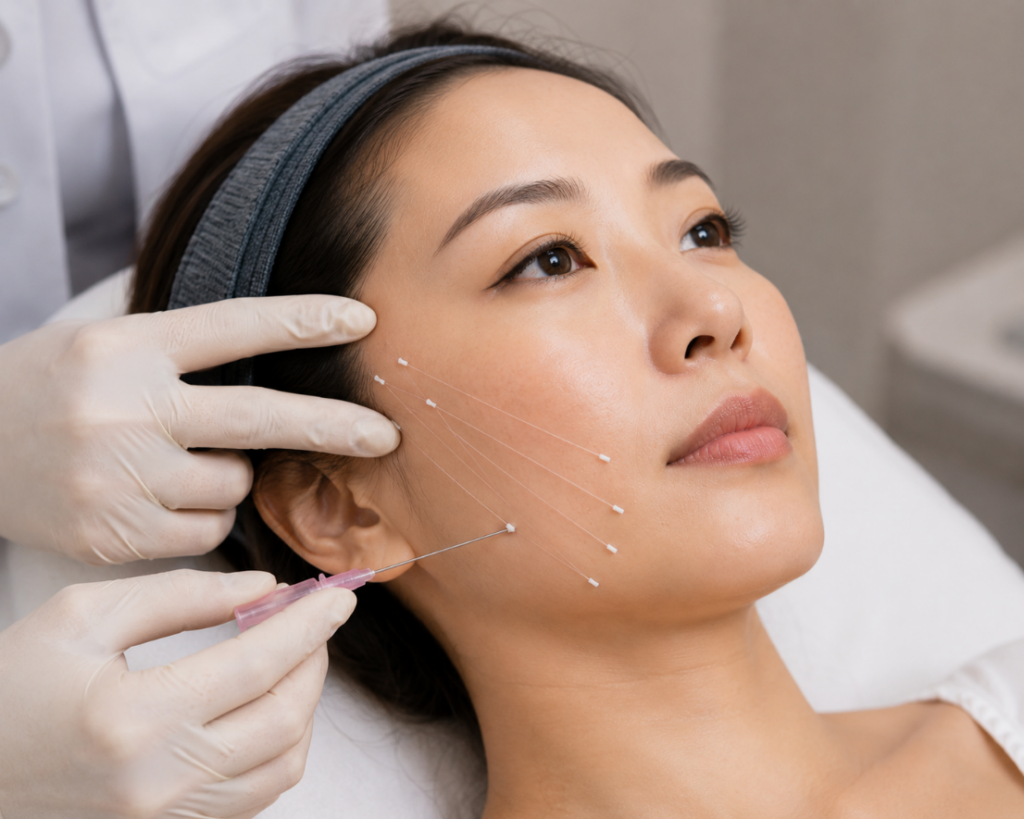
A thread lift is a minimally invasive procedure in which dissolvable threads are inserted beneath the skin to create a mechanical lifting effect. Depending on the thread type, the threads may contain small barbs or cones that anchor onto tissue and reposition sagging areas upward.
The threads may also stimulate some collagen production [4] as they dissolve over time. Different thread designs are used for different purposes: some are intended primarily for collagen stimulation and skin quality, while others focus on stronger lifting and tissue repositioning.
Thread lifts are considered a procedural treatment and typically involve more downtime than non-invasive options. Mild swelling, bruising and tenderness are common in the days following the procedure. As with any minimally invasive treatment, results depend heavily on patient selection, the degree of laxity being addressed, and clinical technique.
Thread lifts are not a treatment we perform at Cove Aesthetic Clinic. The information above is provided for educational purposes, to help you understand how this option works and how it compares to RF skin tightening.
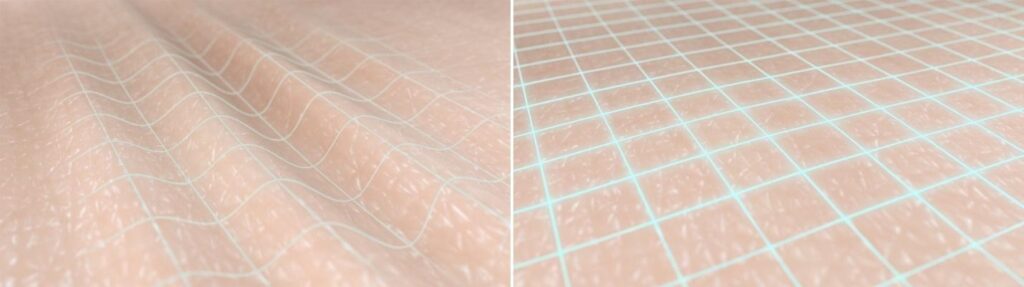
Both treatments address skin laxity, but they work in fundamentally different ways: one lifts and repositions, while the other rebuilds from within.
| Thread Lift | RF Skin Tightening | |
| How it works | Absorbable threads inserted under the skin to physically lift and reposition tissue | Radiofrequency energy heats the deeper layers of skin to stimulate collagen production |
| Type of procedure | Minimally invasive (needles/cannula) | Non-invasive |
| Downtime | A few days to a week | Minimal to none |
| Results | Immediate lift, improves further as collagen builds | Gradual. Develops over weeks to months |
| Best for | Moderate to significant laxity, visible sagging | Mild to moderate laxity, skin quality and tightening |
| Approximate duration* | 1–2 years | 1–2 years with maintenance |
| Discomfort | Local anaesthetic used; some soreness after | Warm sensation during treatment, generally well tolerated |
*Results vary depending on individual skin condition, age, lifestyle factors, and treatment plan.
The right treatment depends on your skin condition, how much laxity you’re dealing with, and what kind of experience you’re looking for.
Thread lifts are generally considered for patients with moderate to significant laxity who want an immediate, mechanical lift and who are comfortable with a minimally invasive procedure and a few days of downtime. This is a treatment best discussed with a provider who performs it.
RF skin tightening tends to suit patients at an earlier stage of laxity who prefer a non-invasive approach with minimal downtime. It works progressively through collagen stimulation, making it a good fit for those who want gradual, natural-looking improvement or who want to maintain results over time. At Cove Aesthetic Clinic, this is the treatment approach we specialise in.
A few questions worth considering before deciding:
The most reliable next step is always a consultation with an aesthetic doctor, who can assess your skin in person and recommend the most appropriate path, whether that’s RF tightening, a referral for thread lift, or a combination approach.
Some patients with both structural laxity and reduced skin quality may benefit from a combination of the two treatments, as they address different aspects of facial ageing. In clinical practice, RF tightening is often used to improve skin firmness and collagen density, while thread lifts provide the mechanical repositioning that collagen stimulation alone cannot achieve.
This kind of combination approach is something that would need to be assessed and planned by a doctor who offers both treatments. If your consultation suggests that a combination approach, including thread lifts, may better address your concerns, our doctors will explain your options and guide you on the most appropriate next steps.
Skin sagging is a gradual process: by the time it becomes visible, the underlying changes have often been accumulating for years. Understanding the science behind it is the first step toward addressing it effectively.
Whether your skin needs collagen stimulation, structural support, or simply a clearer picture of what’s happening beneath the surface, today’s aesthetic treatments offer targeted options for every stage of laxity.
During your consultation at Cove Aesthetic Clinic, our doctor will assess your skin laxity, discuss your aesthetic goals, and recommend the most appropriate treatment approach for where your skin is right now. If you have been considering treatment to contour your face and tighten your skin, schedule a consultation with us today.
The longevity of results depends on individual factors such as age, skin quality, and the degree of laxity. Thread lifts are generally understood to provide longer-lasting structural lifting, as the threads physically reposition tissue beneath the skin. RF treatments work through progressive collagen stimulation and typically require maintenance sessions over time. Neither treatment produces permanent results, and individual outcomes vary. A doctor can advise on what to realistically expect based on your skin.
RF skin tightening is non-invasive — it does not involve needles, threads, or incisions, which generally means lower procedural risk and minimal downtime. Thread lifts are minimally invasive and carry a different risk profile, including the possibility of bruising, swelling, asymmetry, or thread-related complications. Both treatments carry some level of risk and should only be performed by qualified medical professionals following a proper clinical assessment. The right choice depends on your skin, your health history, and your goals.
The number of sessions depends on your individual skin condition, the degree of laxity being addressed, and the RF technology used. At Cove, our doctor will assess your skin during your consultation and recommend an appropriate treatment plan. Maintenance sessions are typically advised over time as collagen continues to remodel and natural ageing progresses.
Some RF devices are designed primarily for skin tightening, while others may also affect fat layers depending on the depth and intensity of energy delivered. In certain individuals, deeper RF treatments may contribute to some fat reduction alongside collagen stimulation. Whether this is desirable depends on the patient’s facial anatomy and goals. For patients who already have lean facial volume, this may not be appropriate. Treatment selection and energy settings are tailored accordingly.
Overcorrection or excessive lifting during a thread lift procedure can result in visible irregularities, unnatural tightness, or an unnatural facial contour. When performed conservatively by an experienced practitioner with appropriate patient selection, thread lifts are generally intended to produce subtle lifting while maintaining natural facial movement. As with any procedure, outcomes depend heavily on technique, patient suitability, and expectations.
RF tightening can help with mild early jowling by stimulating collagen and gradually improving skin firmness around the jawline. For more pronounced jowls, where deeper tissue descent is involved, collagen stimulation alone may not produce sufficient improvement, and structural lifting options may need to be considered. The most appropriate approach depends on the severity of laxity and the underlying cause, which is something our doctor can assess during your consultation.
Whether thread lift and RF treatments can be combined in the same session is a clinical decision that depends on the individual patient’s skin condition and the extent of treatment planned. This is a question best directed to the provider performing the thread lift, as Cove does not offer this procedure. If you are exploring a combination approach, our doctor can advise on what role RF tightening might play in your overall plan.
1. Quan, T., Qin, Z., Xia, W., Shao, Y., Voorhees, J. J., & Fisher, G. J. (2009). Matrix-degrading metalloproteinases in photoaging. The journal of investigative dermatology. Symposium proceedings, 14(1), 20–24. https://doi.org/10.1038/jidsymp.2009.8
2. Arnal-Forné, M., Molina-García, T., Ortega, M., Marcos-Garcés, V., Molina, P., Ferrández-Izquierdo, A., Sepulveda, P., Bodí, V., Ríos-Navarro, C., & Ruiz-Saurí, A. (2024). Changes in human skin composition due to intrinsic aging: a histologic and morphometric study. Histochemistry and cell biology, 162(4), 259–271. https://doi.org/10.1007/s00418-024-02305-w
3. Meyer, P. F., de Oliveira, P., Silva, F. K. B. A., da Costa, A. C. S., Pereira, C. R. A., Casenave, S., Valentim Silva, R. M., Araújo-Neto, L. G., Santos-Filho, S. D., Aizamaque, E., Araújo, H. G., Bernardo-Filho, M., Carvalho, M. G. F., & Soares, C. D. (2017). Radiofrequency treatment induces fibroblast growth factor 2 expression and subsequently promotes neocollagenesis and neoangiogenesis in the skin tissue. Lasers in medical science, 32(8), 1727–1736. https://doi.org/10.1007/s10103-017-2238-2
4. Soen, M., Hidayat, M., & Widowati, W. (2025). Enhancing dermal collagen density towards youthfulness: A comparative study of PCL, PLLA, and PDO thread implantation in aging rats model. Iranian journal of basic medical sciences, 28(2), 151–157. https://doi.org/10.22038/ijbms.2024.80494.17428
5. Kim J. (2024). Comparative Three-dimensional Analysis of Facial Lifting Effects across Five Aesthetic Units following Continuous Radiation 115-Watt 6.78-MHz Monopolar Radiofrequency Therapy. Plastic and reconstructive surgery. Global open, 12(9), e6137. https://doi.org/10.1097/GOX.0000000000006137
6. Hong, G. W., Kim, S. B., Park, S. Y., Wan, J., & Yi, K. H. (2024). Thread Lifting Materials: A Review of Its Difference in Terms of Technical and Mechanical Perspective. Clinical, cosmetic and investigational dermatology, 17, 999–1006. https://doi.org/10.2147/CCID.S457352
7. Cohen, J. L., Rivkin, A., Dayan, S., Shamban, A., Werschler, W. P., Teller, C. F., Kaminer, M. S., Sykes, J. M., Weinkle, S. H., & Garcia, J. K. (2022). Multimodal Facial Aesthetic Treatment on the Appearance of Aging, Social Confidence, and Psychological Well-being: HARMONY Study. Aesthetic surgery journal, 42(2), NP115–NP124. https://doi.org/10.1093/asj/sjab114
8. Li, K., Meng, F., Li, Y. R., Tian, Y., Chen, H., Jia, Q., Cai, H., & Jiang, H. B. (2022). Application of Nonsurgical Modalities in Improving Facial Aging. International journal of dentistry, 2022, 8332631. https://doi.org/10.1155/2022/8332631